
Published on
Custom Bulk Bags: Every Option, Step by Step
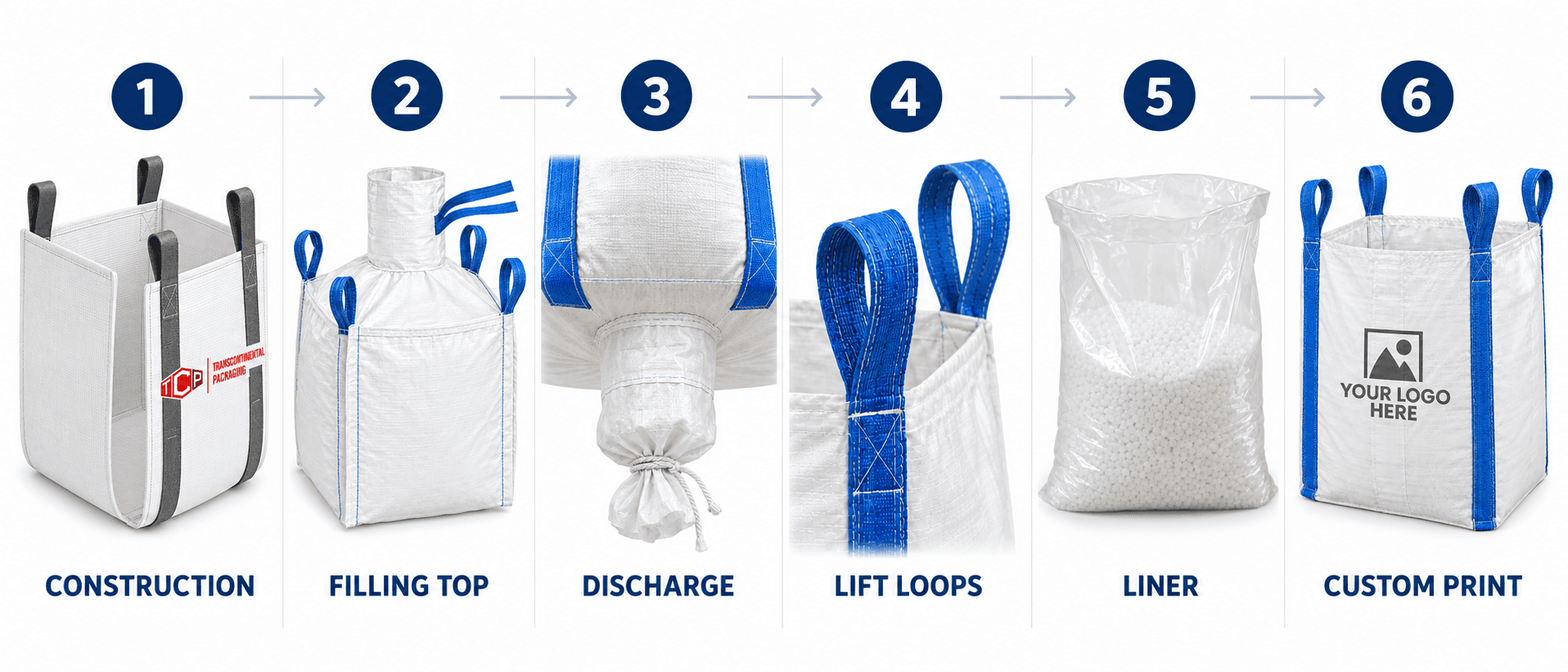
Custom bulk bags are specified, not picked off a shelf. Each order is a short chain of decisions about static, construction, filling, discharge, lifting and lining, and each answer narrows the next.
This is the order we work through with buyers at Transcontinental Packaging, using the option names on our product pages. Most answers come from your material and your filling line, and a custom FIBC largely follows from those two.
Material and static type come first
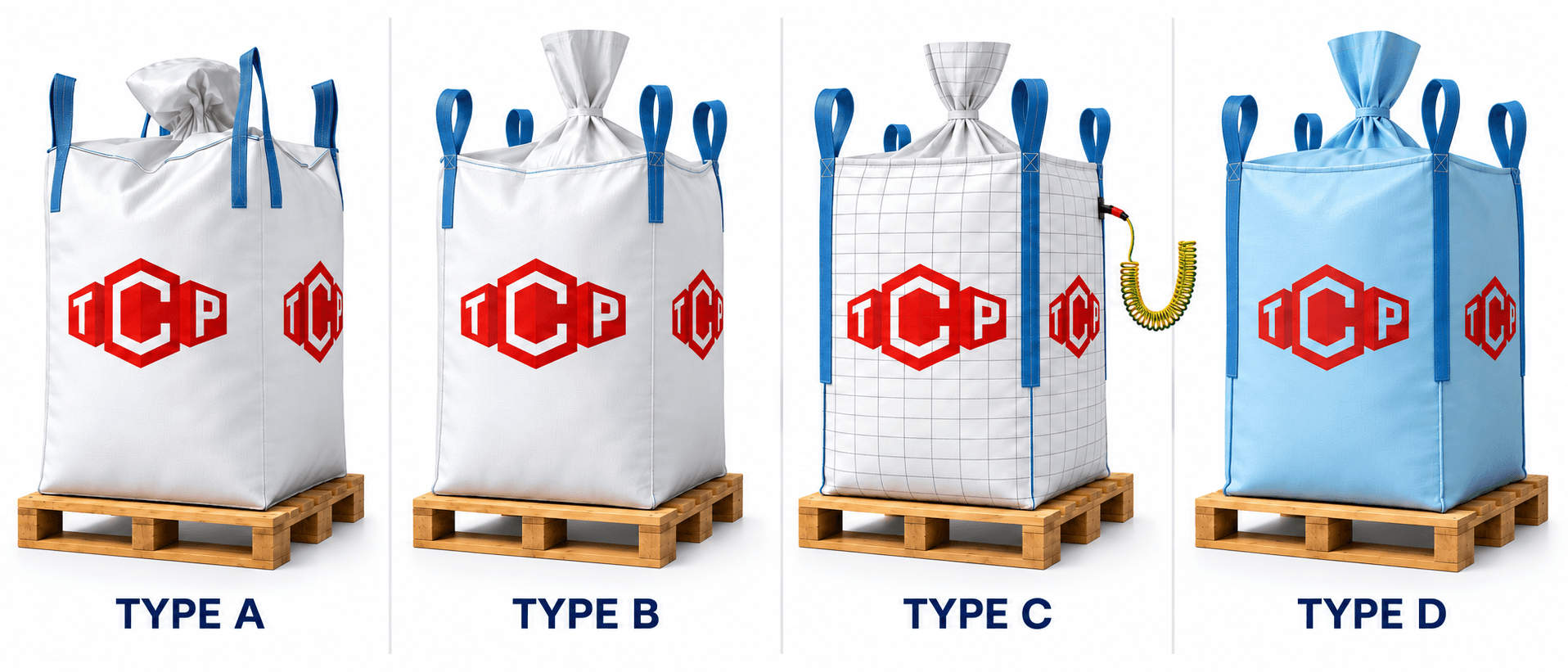
Your material and site decide the static type; preference does not. Type A has no static protection and suits sites with nothing flammable in or near the bag. Type B stops propagating brush discharge, the most energetic kind, but is not antistatic and has no place near flammable vapors.
Type C has interconnected conductive threads and needs a verified ground connection each time it is filled or emptied. Type D dissipates charge by itself, with nothing to connect. If grounding cannot be guaranteed everywhere, we specify Type D, since an ungrounded Type C is a greater hazard than an unprotected bag. Our guide to FIBC types and static protection compares all four.
UN certification is settled here too: a UN design is rated at a 6:1 safety factor, against 5:1 for every other bag we supply, and the approval fixes its construction, fabric and loops.
Construction: U-panel, four-panel or circular
Construction, how the body is cut and sewn, drives shape, seam placement and price. U-panel bulk bags run one piece of fabric up both sides and under the base, so the load travels through unbroken cloth rather than a stitched joint. It is the best strength per dollar and our default.
Four-panel construction sews four walls together and fills out squarer, so it palletizes tighter and wastes less container space. A circular bag is woven as one tube, leaving fine powder no vertical seam to escape through, and with no vertical sewing it is the least expensive build to produce. The catch: it goes round when full and stacks worst of the three.
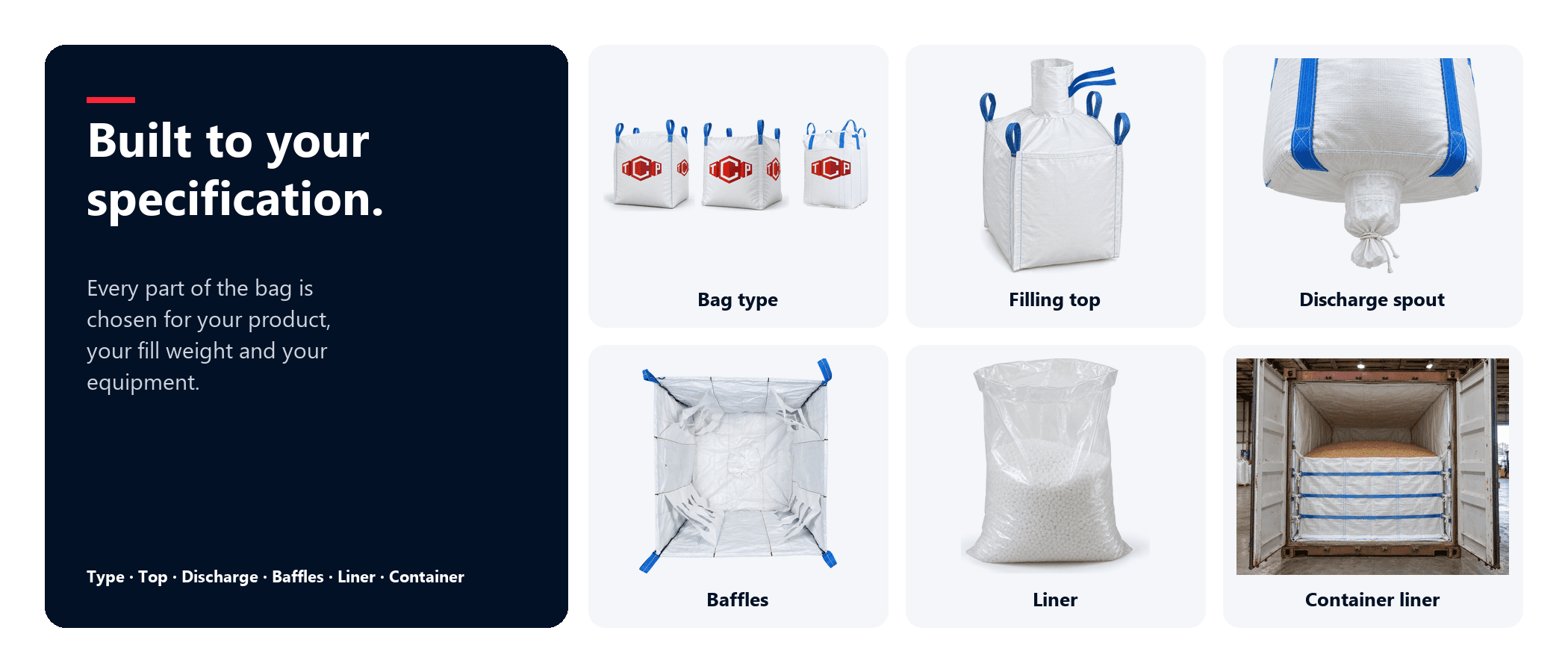
Baffles are an option, not a bag type: fabric panels sewn across the inside corners that keep the bag cubic as it fills. Expect roughly 25 to 30 percent more volume on the same footprint and steadier stacks. Send us the bag dimensions and we can estimate the container space saved.
Then load. Many buyers start from 1 ton bulk bags, meaning one metric tonne, about 2,205 lb. Give us the real fill weight and material density and we size the bag to them.
How the bag fills and how it empties
Filling tops
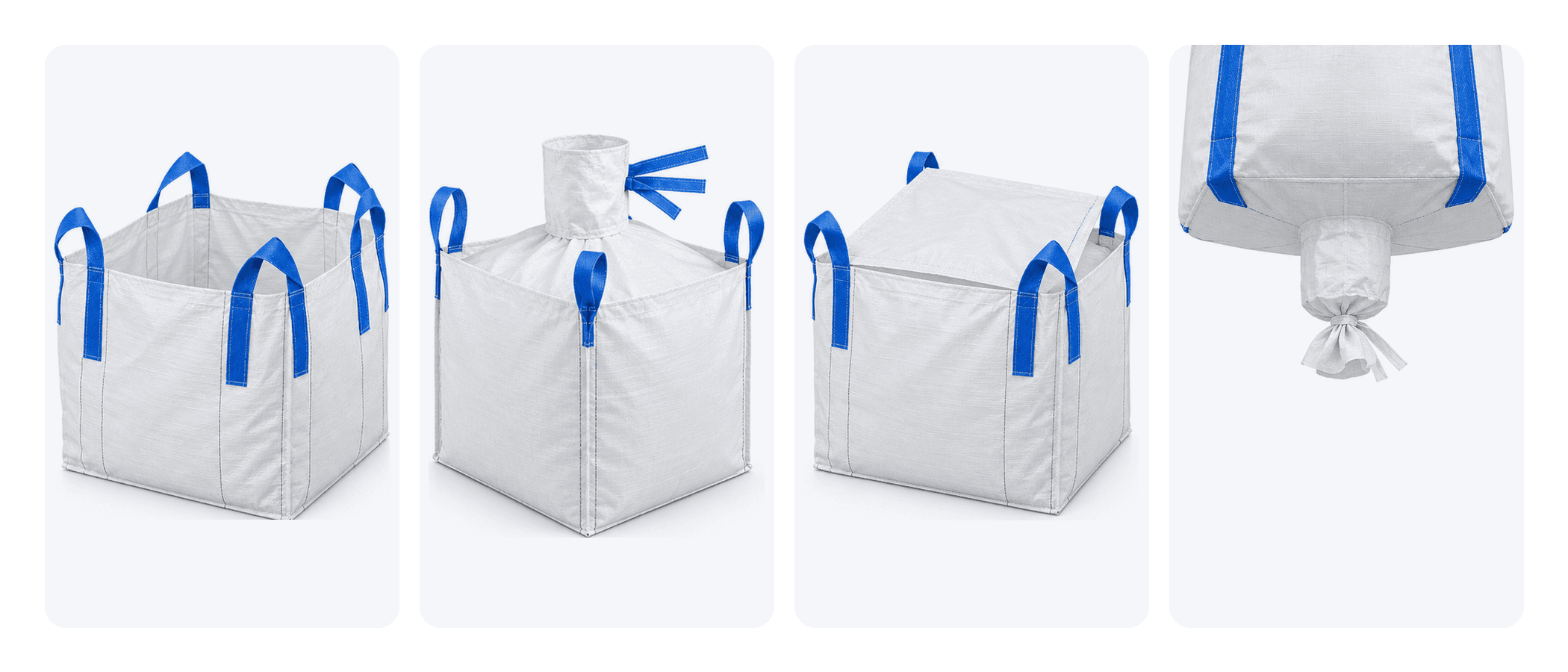
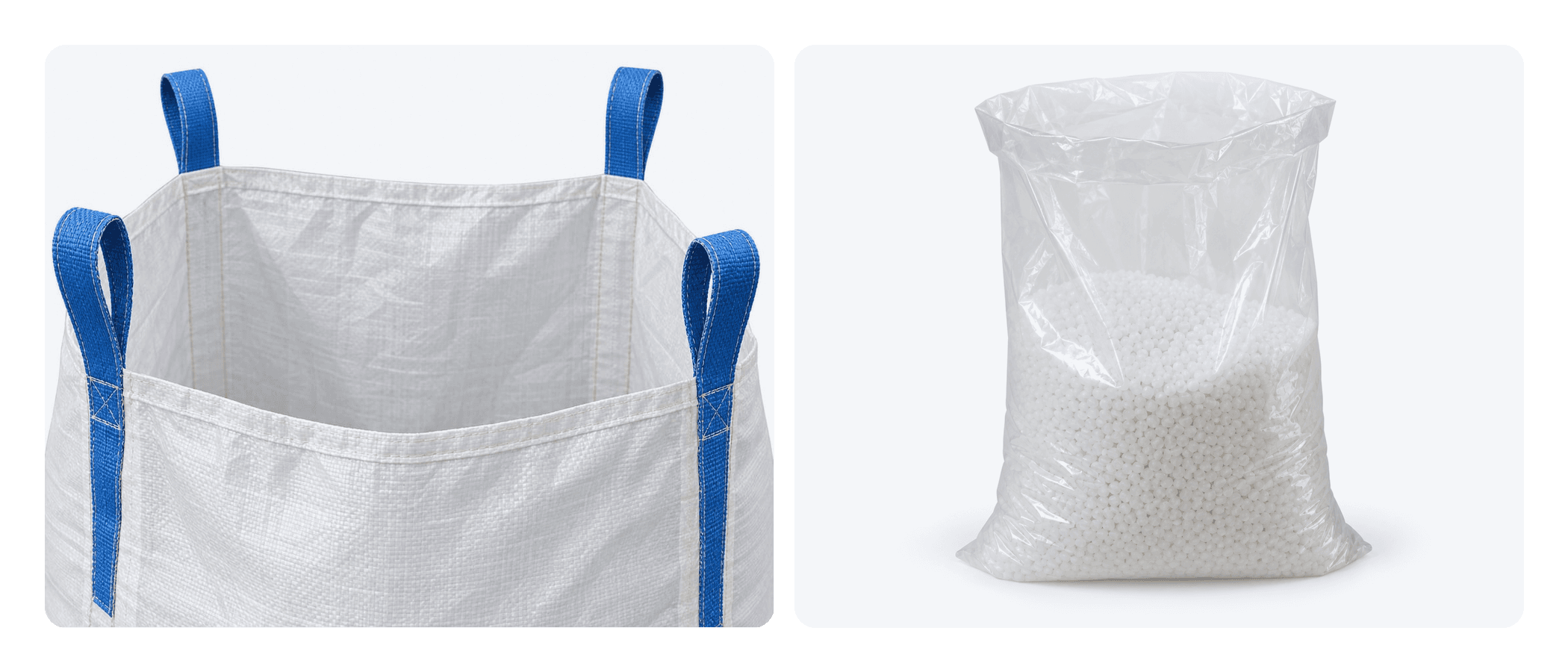
The top must meet your filling equipment. A spout top is a sewn-in sleeve that fits around the filling head and keeps dust in the line; 14 by 18 inches is standard, sized to your head, and a flap can cover it in transit. A duffle top opens the full width for bulky product dropped from a chute or loader. An open top fills fastest when dust and rain are no issue, and a flap top ties one panel over the mouth. Conical and double spout tops are also available.
A flour mill filling through a sealed head wants a spout top. A recycler tipping shred off a conveyor does better with a duffle or open top.
Discharge bottoms
A discharge spout, also 14 by 18 inches as standard, meters free-flowing product into a hopper; specify it wider if the material bridges. A conical discharge helps slow-flowing material empty completely. Full bottom discharge opens the whole base for loads that will not pass a spout, such as crumb rubber or mixed reclaim. A flat bottom stays closed for product that is tipped out or cut free, and a petal or iris closure keeps a spout clean in transit.
Lift loops
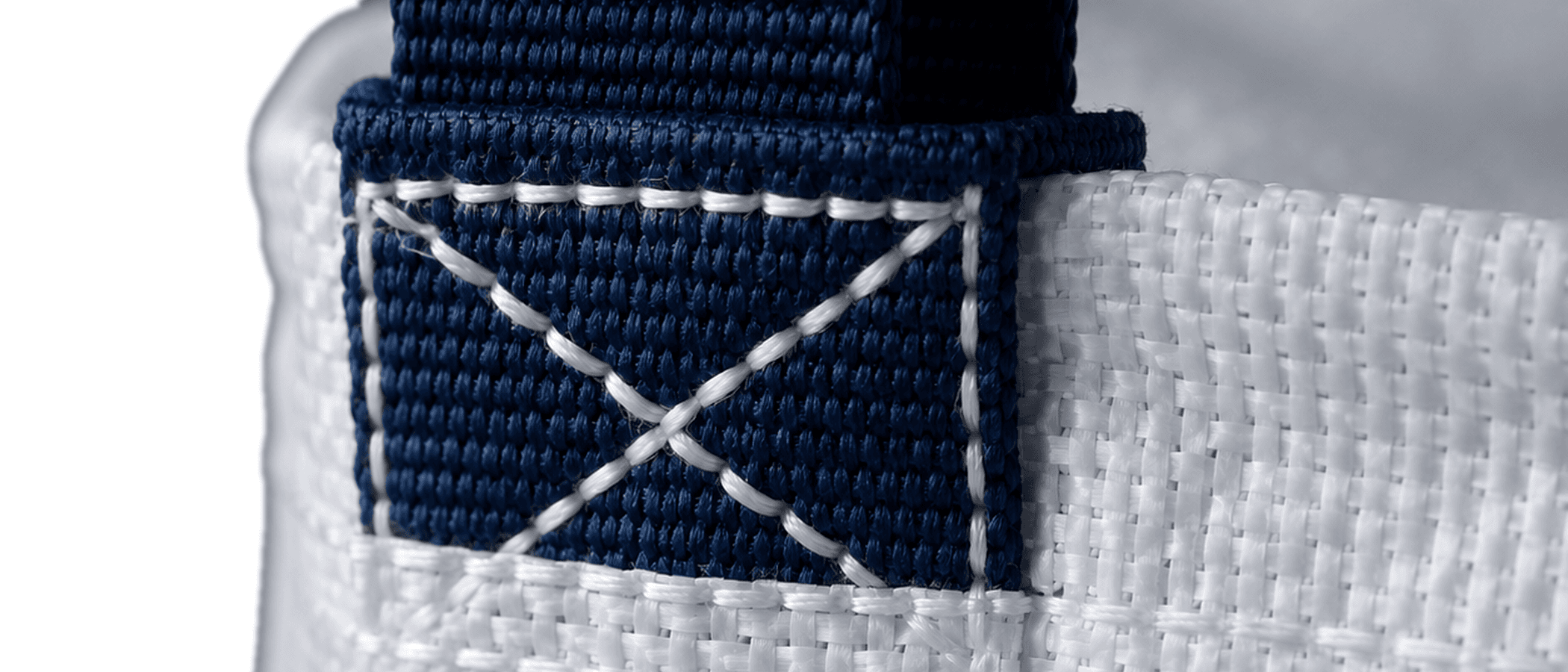
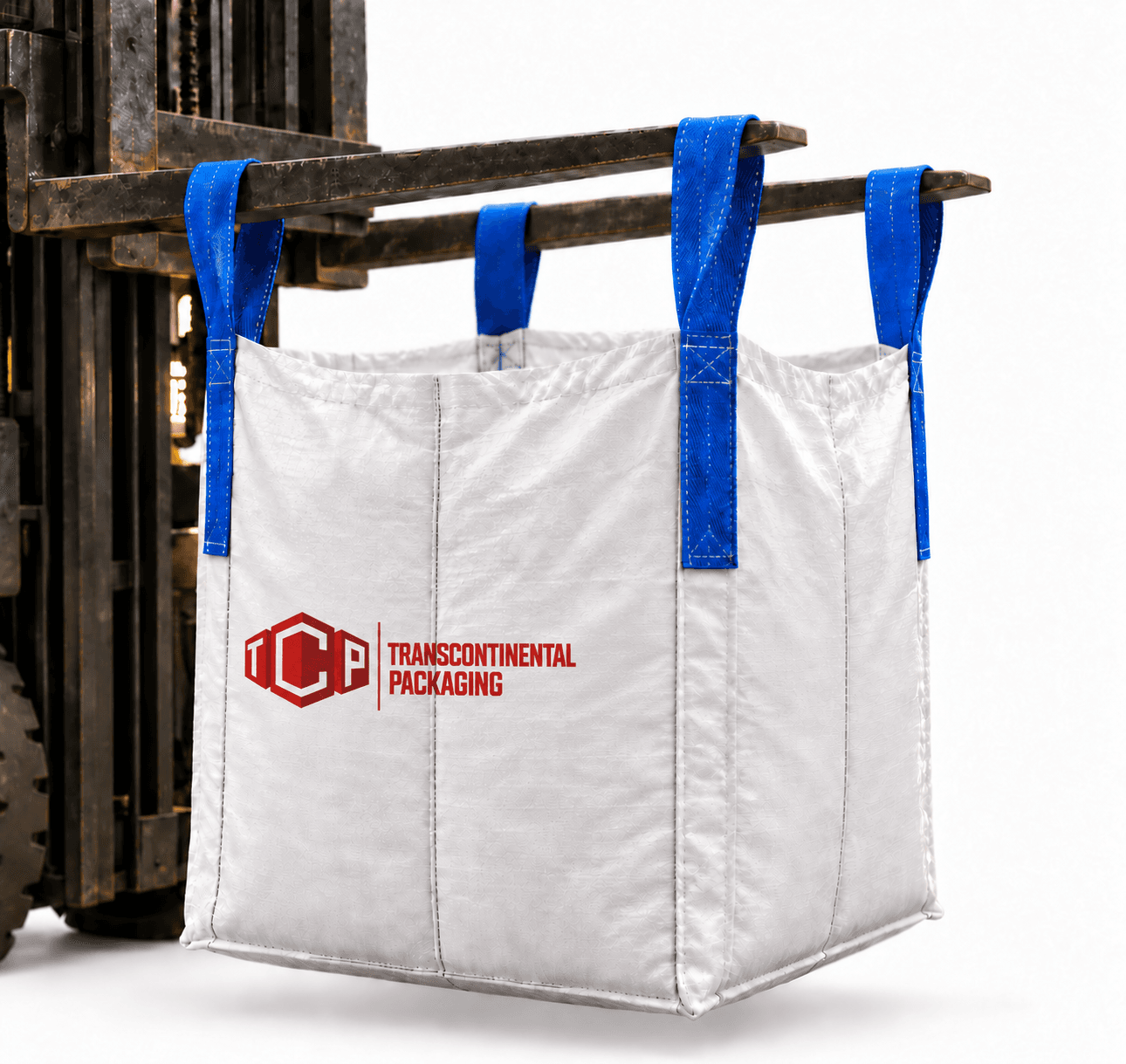
Your material sets the static type; your forklift sets the loops. Corner loops, one per corner seam, are the standard and cheapest. Cross corner loops stand upright for an easier pick and are normally built on circular bags. Tunnel loops are fabric sleeves the forks slide through, useful where overhead clearance is tight. Stevedore straps let a bag be picked from one or two points, and double loops are also available.
Coating and liners
Uncoated fabric breathes and is the default; coated fabric adds a thin polypropylene layer against fine powder and moisture. Sugar shows why these choices travel together: it absorbs moisture and can escape an open seam, so barrier and seams are chosen as a pair.
Most bags need no liner. A loose liner is the low-cost guard against fine powder; a glued-in liner stays put through filling and discharge, which food and pharmaceutical auditors expect. Moisture-sensitive product takes polyethylene, and foil handles hot fills above 165°F. In a Type B, C or D bag an ordinary polyethylene liner can cancel the fabric's protection, so the liner is specified with the fabric, usually as an antistatic grade. See bulk bag liners for gauges and fittings.
Seams, print and finishing
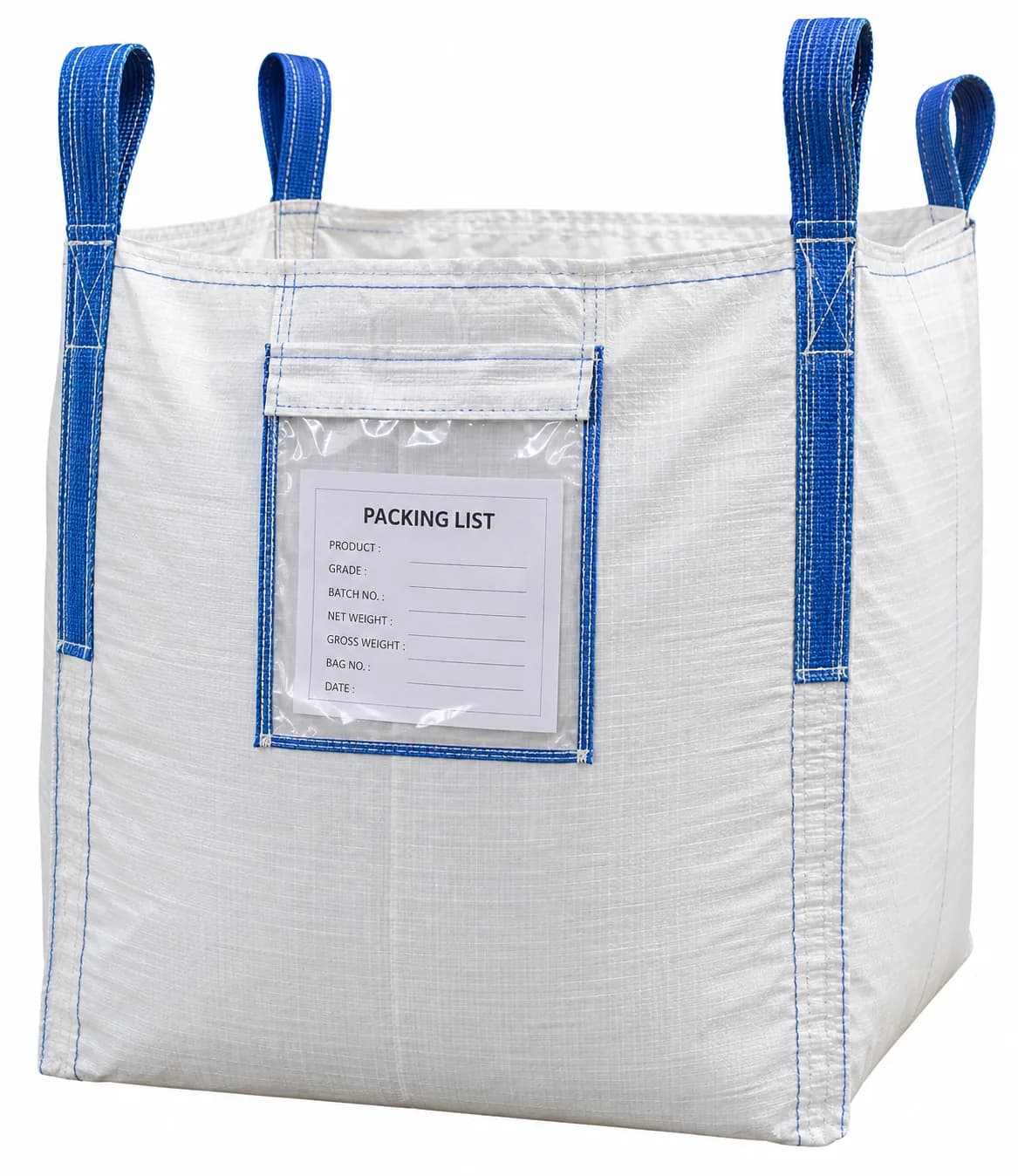
Sift-proof seams add a filler cord inside the stitching to close the needle holes fine powder escapes through, and abrasive loads like sand can take felt-reinforced or J-fold seams. Custom print covers up to four sides for branding and lot codes. A sealed document pouch comes standard, safety bands add strength at the top, and Type C bags get carbon grounding tabs.
Food and pharmaceutical grade
Grade sets how a bag is made and documented, not its shape. Our food-grade FIBC bags use 100% virgin polypropylene resin and clean room production, with BRC, HACCP and AIB accreditation behind the line. FDA food-grade liners come in blue, clear or green; auditors often prefer blue because a stray piece is easy to spot.
Pharmaceutical grade keeps the virgin resin but tightens production, cleaning and paperwork to your own program. It is independent of static type: a pharmaceutical-grade Type D circular bag is an ordinary request.
Custom bulk bag options at a glance
| Option | What it does | Choose it when |
|---|---|---|
| Type A, B, C or D | Sets static protection | Always; material and site decide |
| U-panel | Load on continuous fabric | Most jobs; best value |
| Four-panel | Fills out square | Stacking and container space matter |
| Circular | No vertical seams | Fine powder or lowest cost |
| Baffles | Holds a cube shape | Cube efficiency comes first |
| Spout top | Seals to a filling head | Automated or dusty filling |
| Full bottom discharge | Whole base opens | Material that won't flow |
| Tunnel loops | Forks pass through a sleeve | Low overhead clearance |
| Antistatic liner | Keeps the static rating | Lined Type C or D bags |
| Sift-proof seams | Seals stitch holes | Very fine powder |
The fastest way to a specification
Build a Bag walks the same path. It asks about your material, site, filling line and lifting, then draws the bag in 3D and explains every line of the specification. With a spec sheet in hand, you can enter the build directly and the tool flags conflicts rather than silently changing them.
Our specialists confirm the recommendation against your material data and site before production. Send it from the results page, or request a quote with your material, fill weight and volume, and we build to your specification.
Related products: ventilated bulk bags for produce, UN certified bags for hazardous goods and circular bulk bags for fine powders.
Explore our packaging product range or visit the Transcontinental Packaging homepage to learn about our company and the industries we serve.